Perm Hair Perth: Types, Cost, Aftercare and How Long It Lasts
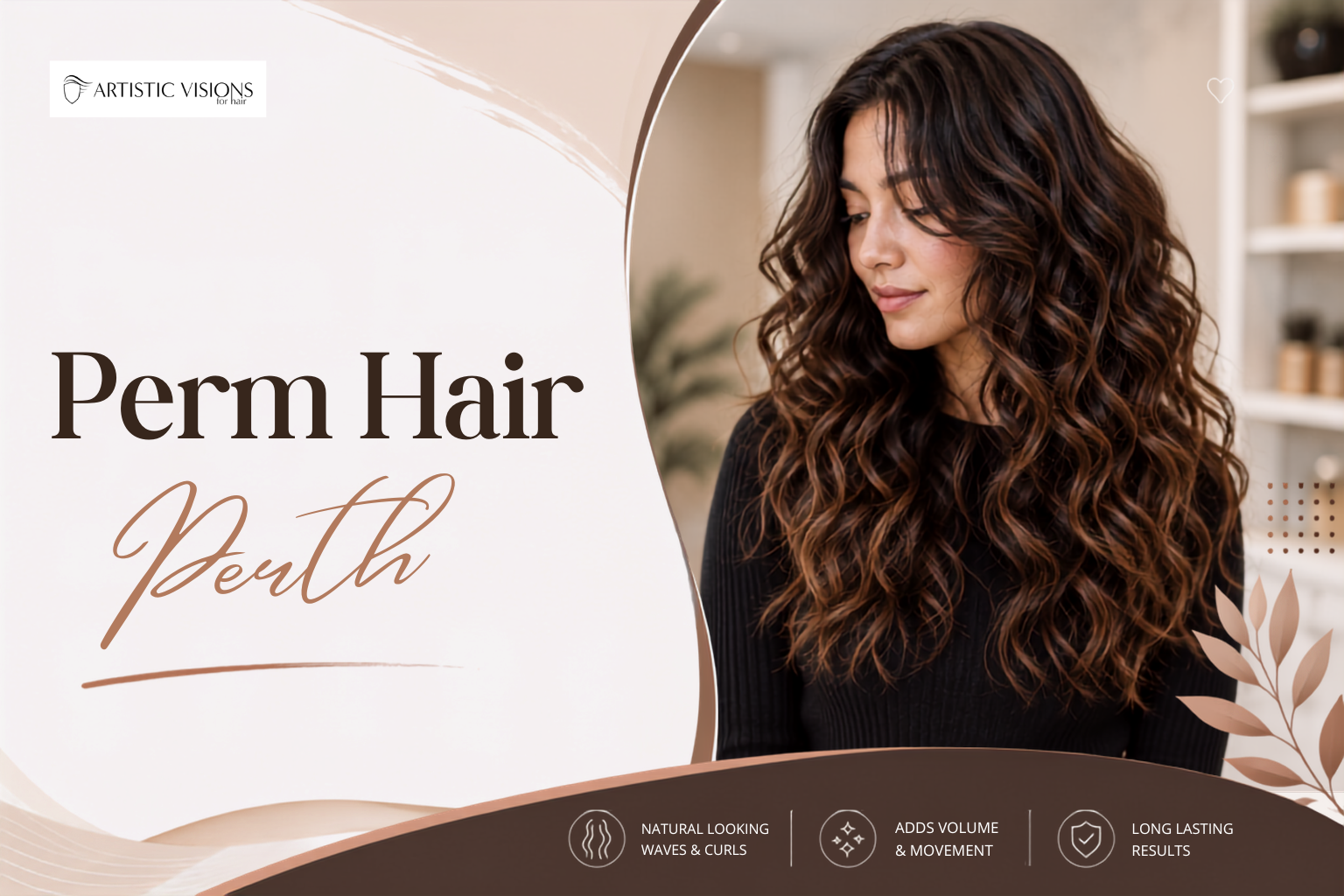
Want more volume, movement and lasting curls without spending every morning styling your hair? Perm hair can give straight, flat or hard-to-style hair a completely different look, from soft, natural waves to defined curls and added root volume. But choosing a perm isn't simply about picking the curl you like in a photo. Your hair type, length, condition and styling goals all affect which technique will work best.
If you're considering perm hair in Perth, this guide covers the most popular options, including digital, body wave, root and traditional perms.
What Is a Perm Hair Treatment (And How Does It Actually Work)?
A perm, short for "permanent wave," is a chemical service that restructures the internal bonds of your hair, then resets them around a tool to hold a new shape. It works by using a solution to break the disulfide bonds inside each strand, reshaping the hair, then applying a neutraliser that locks the new bonds in place.
Unlike a keratin treatment, which smooths the cuticle without touching your hair's internal structure, a perm changes the hair's shape from the inside out. The chemically treated section doesn't simply return to its original texture after a few washes, though the curl can gradually loosen over time with washing, styling and general wear.
Does a Perm Curl or Straighten Hair? Clearing Up the Confusion
This trips up a lot of people, and it's a fair question: "perm" describes the chemical process, not one fixed result, so a perm can technically go either direction.
- Curly or wave perms (what most people mean by "a perm"): hair is wound around rods or rollers, so the bonds reset into a curved shape. This covers digital perms, body wave perms, spiral perms and root perms, all covered below.
- Straight perms (also called Japanese straightening or thermal reconditioning): hair is combed flat and held straight while the same bond-breaking chemistry processes it, so the bonds reset in a straight line instead.
In Australian salons, if you book "a perm" without specifying further, it's almost always assumed you mean the curling version; that's the industry default. If straightening is genuinely your goal, ask your stylist specifically for a "straight perm" or "Japanese straightening," or look at chemical straightening or keratin smoothing instead, since those are usually the better-suited options for reducing curl rather than adding it.
Disclaimer: This guide focuses on the curling side of perms, since that's what the vast majority of Perth clients searching for "perm hair" are actually after.
There are two broad methods for creating curl:
- Cold perms (alkaline perms): these use a chemical solution, usually ammonium thioglycolate, to form the curl without heat. They tend to give a more classic, defined curl.
- Hot perms (digital perms): these use heated, temperature-controlled rods alongside a different chemical formula, creating looser, more natural-looking waves. Processing style aside, how much any perm affects hair condition still comes down to your hair's health, the technique used and how well it's aftercared, rather than the method alone.
Every reputable salon should start with a consultation before touching your hair with chemicals, because the right rod size, formula strength and technique depend entirely on your hair's current condition, thickness and history.
Types of Perms: Digital, Body Wave, Root and More Compared
Not all perms are created equal, and the names get thrown around loosely online. Here's a straightforward breakdown of the main types you'll actually be offered in a Perth salon.
|
Perm Type |
Best For |
Result |
Typical Longevity* |
|
Digital Perm |
Thick, coarse or highly resistant hair |
Loose, natural-looking waves |
4–8 months |
|
Body Wave Perm |
Straight or thin hair, medium to long length |
Soft, relaxed volume and movement |
3–5 months |
|
Root Perm |
Fine, flat hair needing lift at the scalp only |
Volume at the roots, natural length kept |
Around 4–6 weeks |
|
Spiral Perm |
Shoulder-length or longer hair |
Tight, corkscrew curls |
5–6 months |
|
Cold (Traditional) Perm |
Most hair types, shorter to medium lengths |
Classic, defined curl |
3–6 months |
Actual results vary depending on hair type, growth rate, washing frequency, styling and technique.
Expert Tip: Fine hair generally handles root perms, body waves or digital perms better than tight spiral perms, since fine strands can struggle to hold a very tight curl pattern without extra breakage risk.
A proper consultation should always assess your hair's current health before recommending rod size, and viewing our hair gallery can help you picture which result suits you.
Digital Perm: Best for Thick or Resistant Hair
The digital perm is one of the newer techniques, and it's become popular with anyone wanting movement without stiff, obviously "permed" curls. Temperature-controlled rods heat the hair while a specially formulated solution processes it, often with a different processing profile than a traditional cold perm.
It suits thick or coarse hair that resists holding a shape, and clients chasing a soft, undone wave rather than a defined ringlet. The trade-off is time and cost: digital perms usually take longer in the chair and sit at the higher end of the price scale, due to the specialist equipment involved.
Body Wave Perm: Best for Straight or Flat Hair
If your hair is straight, thin, or just falls flat by lunchtime, a body wave perm is usually the entry point stylists recommend. Large rollers are used instead of tight rods, creating loose, natural-looking waves and volume rather than defined curls.
It's one of the lower-maintenance perm options, and tends to grow out more gently than a tighter curl pattern, since there's less contrast between the permed length and your natural regrowth.
Root Perm: Best for Volume Without a Full Curl
A root perm, sometimes called a partial perm, only treats the hair close to the scalp, leaving the rest of your length untouched. It's the go-to option if your only real complaint is flat roots and a lack of volume, rather than wanting curl throughout.
Because it only affects a small section of hair, it processes faster than a full perm and is gentler overall. It's also the shortest-lived, typically needing a refresh well before a full body wave or digital perm would.
Perm Hair Cost in Perth: What You'll Actually Pay
Perm pricing in Perth varies fairly widely, depending on hair length, the type of perm, and the salon's experience level with the technique. Indicative Perth salon pricing looks roughly like this:
|
Perm Type / Length |
Estimated Perth Price |
|
Root or partial perm |
From around $120–$180 |
|
Body wave perm (short to medium) |
$150–$300 |
|
Body wave perm (long) |
$250–$390 |
|
Cold/traditional perm |
$120–$390, depending on length |
|
Spiral perm |
$600–$650+ |
|
Men's perm |
From around $250 |
General Perth market pricing across salons sits between roughly $120 and $400 for a standard perm, while specialist spiral and double-wind techniques from experienced perm stylists can run from $600 upward, given the extra time, rod count and skill involved.
Prices are indicative only and provided for general information; actual cost depends on your hair, the salon and the technique used, so confirm exact pricing at consultation.
Perm vs Keratin vs Straightening: Which Chemical Treatment Do You Actually Need?
This is where a lot of clients get stuck. A perm, a keratin treatment and chemical straightening all involve chemical processes, but they do opposite jobs.
|
Feature |
Perm |
Keratin Treatment |
Chemical Straightening |
|
What it does |
Adds curl or wave |
Smooths and reduces frizz |
Removes curl permanently |
|
Changes internal bonds |
Yes |
No |
Yes |
|
Grows out visible line |
Gradually, softly |
No, fades evenly |
Yes, straight ends vs curly roots |
|
Best for |
Straight or flat hair wanting texture |
Frizzy or curly hair wanting smoothness |
Curly hair wanting permanently straight results |
If you already have natural curl or wave and your goal is to tame frizz rather than change your texture entirely, our keratin treatment guide breaks down whether that's a better fit than chemically restructuring your hair.
One more distinction worth making: if you already have natural curl and simply want better definition, less frizz or an easier routine, you don't need a perm at all, since a perm is designed to create a curl pattern that isn't there naturally.
In that case, the right process starts with a curly hair specialist in Perth who can assess and work with the texture you've already got, rather than a chemical procedure that restructures it from scratch.
How Long Does a Perm Last? A Type-by-Type Breakdown
This depends entirely on which type of perm you get, your hair's natural growth rate, and how well you look after it afterwards.
The figures below are general estimates rather than guarantees; actual results vary based on your hair type, growth speed, washing frequency, styling habits and the specific technique used.
- Digital perms tend to last the longest, generally around 4 to 8 months.
- Cold/traditional perms typically last around 3 to 6 months.
- Body wave perms usually sit around 3 to 5 months.
- Root perms are the shortest-lived, generally needing a refresh around the 4 to 6 week mark.
- Spiral perms can last approximately 5 to 6 months with good care.
Because a perm restructures your hair rather than coating it, it doesn't "wash out" the way a keratin treatment gradually does. Instead, it grows out, meaning your natural texture reappears at the roots first, while the permed length holds its curl until you trim it away.
Perm Hair Aftercare: The Rules That Make (or Break) Your Curl
Aftercare is where most perms are won or lost, and the biggest mistakes almost always happen in the first 48 hours.
The First 48 Hours: Non-Negotiable Rules
Your hair's new bonds are still settling in this window, which is why every rule below matters more here than at any other point.
- Don't wash, wet or shower your hair for at least 48 hours after your appointment. Even a "quick rinse" can undo the curl pattern before it's locked in.
- Don't brush or comb through the curls. If you need to detangle, use your fingers gently.
- Don't tie your hair back, clip it, or sleep with it under tight pressure, as this can create dents or flatten the shape in that section.
- Avoid heavy sweating, humidity or swimming during this window.
Stylist Insight: Think of the first 48 hours the way you'd think of concrete curing: it looks set, but it's still forming its final shape. Interfering with it too early is the number one reason a perm ends up patchy or uneven.
Week One: Easing Back Into Your Routine
Once you're past 48 hours, ease back in rather than resuming your full routine straight away. Avoid tight hair ties, hats and high-heat styling tools, and hold off on swimming in chlorinated or salt water where possible, as both can weaken a fresh curl pattern.
Long-Term Care: Keeping Your Perm Salon-Fresh
- Use a sulphate-free shampoo and conditioner, since sulphates strip the moisture your permed hair needs to hold its shape.
- Deep condition weekly. Permed hair is more porous and prone to dryness than untreated hair.
- Air-dry when you can, or diffuse on a low heat setting rather than using high-heat tools regularly.
- Book regular trims every 6 to 8 weeks to keep ends healthy and prevent split ends from working their way up the shaft.
- Sleep on a silk or satin pillowcase to reduce friction and frizz overnight.
Does a Perm Damage Your Hair?
A perm is a chemical process, and like any chemical service, it carries some inherent risk of dryness, increased porosity or breakage, even when it's professionally performed.
What a proper consultation and skilled application do is significantly reduce that risk, rather than remove it altogether. Most problems trace back to a handful of avoidable issues:
- Perming hair that's already heavily bleached, colour-treated or chemically compromised
- Leaving the chemical solution on for too long, or using the wrong strength for your hair's porosity
- Skipping the consultation and assessment stage
- Poor aftercare in the first 48 hours
This is exactly why a genuine consultation matters before booking. A stylist should assess your hair's current condition, previous colour history, and porosity before recommending a perm type, rather than simply taking a booking over the phone.
Who Shouldn't Get a Perm? 4 Warning Signs to Watch For
A perm isn't the right call for everyone. It's generally best avoided, or approached very cautiously, if:
- Your hair is already significantly damaged, breaking or over-processed from bleach
- You've had recent chemical services, such as colour, another perm, or straightening, within the last few weeks
- You have a sensitive scalp or a history of allergic reactions to chemical treatments
- Your hair is extremely fine and prone to breakage
In any of these cases, a consultation-first approach means your stylist can recommend strengthening treatments, or a gentler option like a root perm, rather than a full chemical process your hair isn't ready for.
Why Perth Clients Trust Artistic Visions for Perm Hair
Artistic Visions has been part of the East Perth hairdressing scene since 2001. Every service, including perms, starts with a proper consultation, where your stylist assesses your hair's history, condition, and goals before recommending a technique or rod size, rather than applying a one-size-fits-all approach.
If you're after volume at the roots, soft all-over waves, or a defined curl that actually suits your hair's current condition, Artistic Visions' perm specialists can talk you through which perm type fits your hair and lifestyle, right here in East Perth.
Book your perm consultation with Artistic Visions, and get a plan built around your actual hair, not a generic quote.
FAQs
How long does perm hair last?
Most perms last somewhere between 4 to 8 months, depending on the type. Digital and spiral perms tend to last longest, while root perms need refreshing soonest, usually within 4 to 6 weeks.
Where can I get a perm in Perth?
Perms are offered at salons across Perth, though quality and experience with the technique vary. Artistic Visions in East Perth offers a full range of perm types, starting with a consultation to match the technique to your hair.
Can I dye my hair before or after a perm?
Colour first, perm second, with a couple of weeks in between. Doing it the other way, or too close together, can cause uneven colour or a weaker curl.
Does getting a perm hurt or smell bad?
It shouldn't be painful, though the chemical smell can be strong and the scalp may feel slightly warm during processing. Professional, well-ventilated salons keep this manageable.
Can I straighten my permed hair if I don't like it?
You can, but it means processing already-permed hair a second time, which raises the damage risk. Most stylists suggest waiting it out or trimming the curl out gradually instead.