Best Hair Extensions for Thin Hair in Perth: A Complete Guide
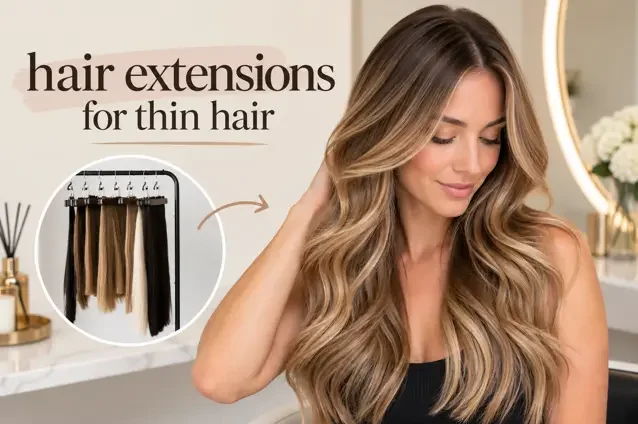
If your hair has always been on the finer or thinner side, you may have wondered whether extensions are even an option for you, or whether they will just pull on hair that is already delicate. The short answer is that thin hair does not rule out extensions.
The right answer depends on your hair's density, its current condition, and whether you are after more volume, more length, or both. No single method works for every head of hair, which is why a proper assessment matters more than a trend.
Fine Hair versus Thin Hair: They Are Not the Same Thing
People use the words "fine" and "thin" interchangeably, but they describe two different things.
Fine hair refers to the width of each individual strand. Thin hair refers to how many strands you have overall; in other words, your density.
You can actually have fine strands with plenty of density, which usually gives you more options with extensions. Or you can have thin, low-density hair made up of coarser strands, which changes the approach completely.
Someone with hair that is fine but dense might handle a wider range of extension types than someone with sparse density, regardless of how thick or fine each strand feels.
This is the first thing a stylist should work out before anything else, because it changes which methods are realistic and how much extension hair you actually need.
There is a simple way to check which category you fall into. Hold a single strand up to the light. If it is hard to see, your strands are fine. Separately, part your hair and look at your scalp. If you can see a lot of scalp through the part, your density is lower. Most people are a mix of both, and that mix is exactly what a stylist needs to see in person before suggesting anything.
Is Your Hair Suitable for Extensions?
What Gets Checked First
Before recommending anything, a stylist should look at how dense your hair is, the condition it is in, whether there is existing breakage, and any past chemical treatments such as bleach, perming, or a keratin smoothing treatment.
A keratin smoothing treatment is different from a keratin bond extension, but both affect how your hair handles extra weight, so it is worth mentioning either one at your consultation. They will also ask what you are hoping to achieve and how much upkeep fits your lifestyle.
When Extra Care Is Needed
If your hair has significant breakage, has been heavily processed, or you have noticed ongoing shedding or scalp sensitivity, that needs attention before adding any extra weight. This is not about diagnosing anything. It simply means that unexplained thinning or shedding is worth having checked by a doctor or a trichologist first, rather than covering it with extensions.
The honest answer here is that suitability has to be assessed, not promised. Anyone telling you that a certain method is safe for absolutely everyone has not looked at your actual hair yet.
The Best Extension Methods for Thin Hair, Compared
There is no single winner that suits every client with fine or thin hair. What matters is matching the method, the amount of hair, and where it is placed to your natural density.
Lightweight hair extensions for fine hair are usually the safer starting point, but the method alone does not guarantee a good result. Hair extension services should always start with that assessment rather than a fixed package.
Extension Types at a Glance
|
Method |
Weight on natural hair |
Best suited for |
Typical upkeep |
|
Tape-in extensions |
Light, spread across a wide strip |
Fine hair with reasonable overall density |
Reapplied roughly every 4 to 6 weeks |
|
Hand-tied or beaded wefts |
Very light, weight spread across many small points |
Lower density hair, especially when volume is the goal |
Moved up roughly every 6 to 8 weeks |
|
Heavy machine wefts or bonded clusters |
Heavier, concentrated in fewer points |
Generally not the first choice for thin or fragile hair |
Varies, often a shorter wear time before hair feels strained |
Why the Method Is Not the Whole Story
Even the lightest method on paper can feel wrong if too much hair is added, or if it is placed over an area that is already thinner than the rest of your scalp. The real decision comes down to five things working together: how the extensions attach, how much they weigh, your natural density, where they sit, and how often you are realistically going to keep up with maintenance appointments.
A stylist who talks you through all five, rather than just naming a method, is doing the job properly.
Volume versus Length: Why the Goal Changes Everything
Not everyone wanting extensions is chasing extra length. Many clients with thin hair are really looking for hair extensions for volume, wanting their hair to look fuller without necessarily going longer.
If volume is the main goal, you generally need less added hair than someone chasing significant length, and it can be placed more strategically through the crown and sides rather than all the way through.
This matters because a full head of long extensions on hair that is already thin can end up feeling heavier than it looks, whereas a lighter, more targeted volume set often gives a more natural result.
So if your honest answer to the question "what do I want from this" is "I just want my hair to look thicker," say that at your consultation. It changes the plan significantly, and it usually means less hair, less cost, and less ongoing upkeep than a full install designed for both length and volume.
It is also worth thinking about where you feel thinnest, whether that is the crown, the sides, or through the ends. Telling your stylist exactly where you would like more fullness helps them plan placement around that area, rather than adding hair evenly across your whole head.
Can Hair Extensions Damage Thin Hair?
What Increases the Risk
Extensions can put strain on natural hair, but it is rarely the extensions themselves causing the problem.
It is usually one of the following: too much hair added for the density available, tight or poorly placed attachment points, skipping maintenance appointments past the recommended window, or rough brushing that tugs at the attachment area instead of working around it.
How to Look After Them
Brush gently, starting from the ends and working upward, supporting the hair near the attachment points rather than pulling straight through. Use a heat protectant before styling tools.
Stick to the maintenance schedule your stylist gives you, since leaving extensions in for too long is one of the more common causes of tension and tangling. When it is time for them to come out, have that done professionally rather than removing them yourself.
Signs to Keep an Eye On
Ongoing discomfort, a pulling sensation at the scalp, unusual tangling right at the attachment points, or noticeable breakage are all reasons to go back to your stylist sooner rather than waiting for your next scheduled visit.
What to Ask at a Consultation for Hair Extensions in Perth
A good consultation should leave you with clear answers, not just a booking. It is also the point where you can be upfront about your budget and how much time you can realistically give to maintenance, since both affect which method makes sense. It is worth asking the following:
- Which method actually suits my density and strand thickness?
- How much hair do I realistically need for what I want?
- Am I better suited to volume, length, or a mix of both?
- Where will the extensions be placed?
- How often will I need maintenance appointments?
- Is there anything about my current hair condition I should know before we start?
If a stylist cannot answer these clearly before you commit, that is worth noting.
Book a Consultation With Artistic Visions
Every hair extension conversation should start with a proper look at your hair, not a sales pitch. At Artistic Visions in East Perth, appointments begin with a real conversation about your hair's condition and what is realistic for your goals, so you know what you are working with before anything is booked in.
You can also browse our gallery to see real results before deciding what is right for you.
Get in touch:
Phone: (08) 9325 1575.
Book a consultation with our team today.
Address: 1/81 Royal Street, East Perth WA.
Frequently Asked Questions
Do I need less hair if I just want volume, not length?
Usually, yes. An install focused on volume typically uses less extension hair, placed through the crown and sides, compared to a set designed to add significant length.
What extension type suits fine hair best?
It depends more on your overall density than on strand thickness alone. Lighter methods that spread the weight out tend to sit better on fine hair, but the right choice still comes down to an individual assessment.
Will extensions definitely damage my thin hair?
Not necessarily. The risk comes from adding too much hair for your density, poor placement, or skipping maintenance, rather than from wearing extensions itself. Proper application and upkeep make the biggest difference.
How do I know if my hair is thinning too much for extensions to be a good idea right now?
If you have noticed ongoing shedding, scalp sensitivity, or thinning that seems unrelated to your usual hair pattern, it is worth getting that checked by a doctor before adding any extra weight to your hair.